
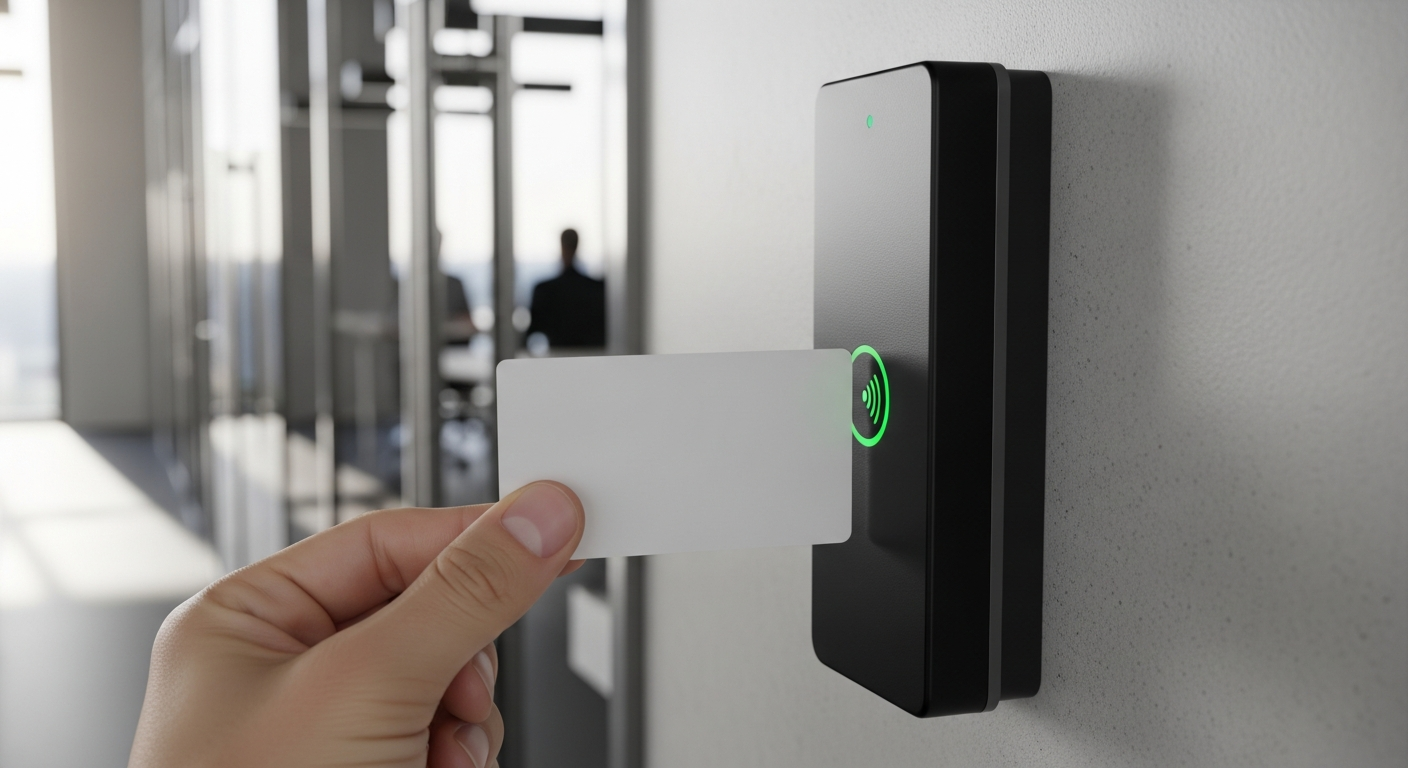
Physical security remains a critical concern for businesses operating across Africa. From the corporate offices of Sandton to the mining operations of the Bushveld Complex, from the port facilities of Durban to the data centres of Nairobi, controlling who enters a premises — and tracking their movements within it — is fundamental to operational security. RFID access control cards have become the standard mechanism for managing physical access, and the technology continues to evolve in response to increasingly sophisticated security requirements.
Proximity Cards: The Workhorse
The most widely deployed access control cards in Africa operate on 125 kHz low-frequency technology. These proximity cards, commonly referred to by the brand names of their dominant formats — HID ProxCard, EM4100, and similar — work on a simple principle: each card carries a unique identification number that is transmitted to the reader when the card comes within range (typically 5 to 15 centimetres). The reader passes this number to a central access control system, which checks the number against a database of authorised users and grants or denies access accordingly.
Proximity cards are popular for good reason. They are inexpensive to produce, extremely durable, and compatible with a vast installed base of readers from manufacturers like HID Global, ZKTeco, Suprema, and Paxton. For many applications — controlling access to an office building, a car park, or a factory floor — the security provided by proximity technology is entirely adequate.
Smart Card Access: Raising the Bar
However, proximity cards have a fundamental security weakness: they transmit their identification number in the clear, without encryption. This makes them vulnerable to cloning — a bad actor with inexpensive equipment can capture a card's ID number from a distance and programme a duplicate card. For organisations with elevated security requirements — financial institutions, government buildings, data centres, and critical infrastructure — this vulnerability is unacceptable.
Smart card access control addresses this weakness by using encrypted communication between the card and reader. Technologies like MIFARE DESFire EV1/EV2, HID iCLASS SE, and SEOS employ mutual authentication protocols, where both the card and the reader must prove their identity before access data is exchanged. The card's unique identifier is never transmitted in the clear, making cloning practically impossible without compromising the encryption keys.
The Mining Sector: Unique Demands
South Africa's mining industry presents some of the most demanding access control requirements on the continent. With over 450,000 workers employed in mining operations, the industry must manage access across sprawling surface facilities, underground workings, and restricted blasting zones. The safety imperative — knowing exactly who is underground at any given moment — elevates access control from a security function to a life-safety system.
Mining access cards must withstand extreme conditions: dust, moisture, temperature fluctuations, physical impact, and constant handling by workers wearing heavy gloves. The cards are often multi-functional, combining access control with time-and-attendance tracking, lamp room management, and safety training verification. Some mining operations integrate RFID cards with vehicle tracking systems, ensuring that only qualified operators can start specific pieces of heavy equipment.
Multi-Site and Multi-Tenant Environments
Corporate campuses, business parks, and multi-tenant commercial buildings present their own access control challenges. A single card may need to grant access to a building's main entrance, a specific floor's lift lobby, a tenant's suite, and shared facilities such as the parking garage and gymnasium — each with different permission levels and time restrictions.
Modern smart card access systems handle this complexity through hierarchical permission structures stored either on the card itself or in a centralised management system. The card becomes a portable credential that carries all the access rights its holder needs, while the back-end system maintains audit trails that record every access event across every controlled point.
Integration with Other Systems
Access control cards increasingly serve as a platform for converged physical and logical security. A single card might grant physical access to a building, authenticate its holder to a computer network, enable cashless payment at the staff canteen, and record time-and-attendance data for payroll purposes. This convergence reduces the number of cards and credentials that employees must carry, simplifies administrative overhead, and creates a unified security posture.
For organisations in regulated industries — banking, healthcare, government — the audit trail generated by converged card systems provides valuable compliance documentation, demonstrating that access to sensitive areas and systems is properly controlled and monitored.
Choosing the Right Access Card
Selecting access control cards requires careful consideration of the existing reader infrastructure, the security level required, the operational environment, and the potential for future system expansion. Organisations planning a new access control deployment should consider smart card technology from the outset, even if the initial security requirements seem modest — the cost difference between a proximity card and a smart card is small relative to the total system cost, and upgrading cards later requires recarding the entire user population.
At Cardzgroup Africa, we supply access control cards across the full technology spectrum, from basic proximity to high-security smart cards, in formats ranging from standard ISO cards to custom-shaped key fobs and wristbands. Whatever your security requirement, we have the manufacturing capability to meet it.